
Constitutional and Privacy Constraints on Law Enforcement Drone Surveillance Under the Fourth Amendment (U.S. and Michigan Focus)
By: PALS Report July 2, 2026
The Case Against Police Drone Deployment as a General Investigatory Tool
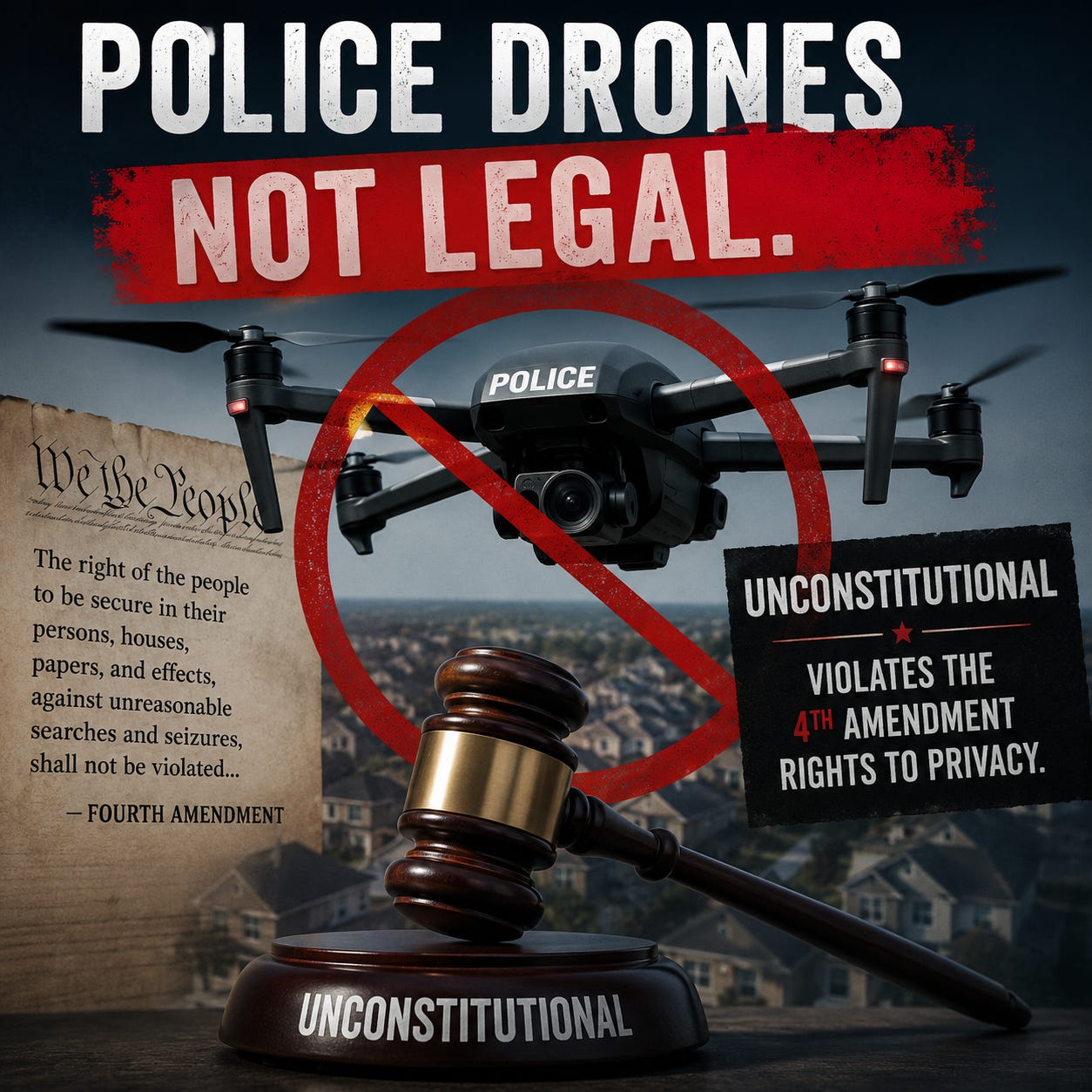
The use of drones by law enforcement agencies as routine surveillance instruments presents substantial constitutional and policy concerns that weigh heavily against their widespread deployment. Under the Fourth Amendment to the United States Constitution, citizens are protected against unreasonable searches and seizures, a protection that has historically been anchored in the concept of reasonable expectations of privacy as articulated in Katz v. United States (1967). While early aerial surveillance cases such as California v. Ciraolo (1986) and Florida v. Riley (1989) permitted limited warrantless observation from public airspace, those decisions were grounded in the assumption that surveillance tools were constrained, infrequent, and comparable to human observation. Modern drones, however, fundamentally alter that assumption by enabling persistent, inexpensive, and highly precise surveillance of private spaces, including curtilage areas traditionally afforded heightened constitutional protection under Oliver v. United States (1984). Because drones can hover, record continuously, and deploy advanced imaging systems at scale, their use as general policing tools creates a surveillance environment that is materially inconsistent with the limited, incidental observation contemplated in earlier Supreme Court precedent. For this reason, the deployment of drones as routine law enforcement tools risks converting narrowly permitted aerial observation into generalized, suspicionless surveillance inconsistent with Fourth Amendment principles.
Fourth Amendment Violations Arising from Warrantless Drone Surveillance
Warrantless drone surveillance implicates core Fourth Amendment protections because it enables government actors to obtain detailed information about constitutionally protected areas without judicial authorization. The Supreme Court in Kyllo v. United States (2001) held that the use of sense-enhancing technology not in general public use to obtain details of the home otherwise unknowable without physical intrusion constitutes a search. Drones equipped with high-resolution cameras, infrared imaging, automated license plate readers, and AI-enhanced tracking systems fall within this doctrinal concern because they significantly expand governmental observational capacity beyond ordinary human perception. Additionally, Carpenter v. United States (2018) established that prolonged, aggregated surveillance can violate reasonable expectations of privacy even when individual data points are exposed to the public. Drone surveillance programs that track movement patterns, revisit properties, or systematically collect imagery over time therefore raise constitutional issues similar to CSLI tracking in Carpenter. Furthermore, under United States v. Jones (2012), the Supreme Court recognized that prolonged GPS-style monitoring implicates Fourth Amendment concerns due to the comprehensive nature of behavioral tracking. Together, these cases demonstrate a clear doctrinal trend: the Constitution prohibits not only physical trespass but also technologically enabled, sustained surveillance that reconstructs private life without a warrant.
Privacy Rights Violations and Constitutional Harms
Beyond Fourth Amendment concerns, police drone surveillance raises independent privacy harms under both constitutional and common law principles of informational privacy. The concept of privacy in American law has long included protection against government intrusion into intimate spaces such as homes, backyards, and other curtilage areas, as reaffirmed in Griswold v. Connecticut (1965) and expanded through modern informational privacy doctrine. Drone surveillance threatens this protection by enabling continuous observation of individuals in spaces where they reasonably expect freedom from government monitoring. Even when drones operate in public airspace, their capacity for zoom imaging, thermal scanning, and persistent monitoring effectively collapses the distinction between public and private life. This creates what courts and scholars describe as a “chilling effect,” discouraging lawful but sensitive personal activity due to fear of surveillance. The risk is amplified when drone data is stored, analyzed, or shared across agencies or third-party vendors, raising concerns under informational privacy principles recognized in cases such as Whalen v. Roe (1977). Consequently, drone surveillance presents not only a search-and-seizure issue but also a broader erosion of privacy norms protected by constitutional structure.
Erosion of Public Trust in Law Enforcement
The deployment of drones for surveillance purposes significantly undermines public trust in law enforcement institutions by altering the perceived relationship between police and community members. Public trust in policing relies on transparency, accountability, and a perception that law enforcement activity is proportionate and justified under law. The introduction of persistent aerial surveillance devices creates a perception of omnipresent monitoring, which can weaken voluntary cooperation with police investigations and reduce community engagement. This concern aligns with empirical studies in constitutional policing literature indicating that perceived surveillance intensity correlates with reduced civic participation and increased distrust in government institutions. Under Terry v. Ohio (1968), the legitimacy of policing authority is closely tied to reasonableness and articulable suspicion, principles that are strained when surveillance is conducted indiscriminately through automated aerial systems. Moreover, public concern is heightened in jurisdictions where drone deployment lacks transparency regarding retention, usage scope, and data sharing policies. As a result, drone programs risk producing a structural legitimacy deficit that undermines long-term law enforcement effectiveness.
PALS Report™ is fully independent, unsponsored, and reader-supported.
No institutional backing. No corporate funding. No hidden agenda.
If you value research-driven analysis on surveillance, constitutional rights, and institutional power—and want to help keep it that way:

Support here: https://buymeacoffee.com/palsreport
Civil Liability Exposure for Police Agencies
Law enforcement agencies that deploy drones without clear statutory limits expose themselves to significant civil liability under 42 U.S.C. § 1983 for violations of constitutional rights. When drone surveillance is used without warrants in circumstances where courts later determine a search occurred, municipalities may face damages claims for unlawful search and seizure under the Fourth Amendment. Additionally, if surveillance is found to target protected curtilage or involve prolonged monitoring without judicial authorization, courts may find violations under Kyllo and Carpenterframeworks, increasing liability exposure. Agencies may also face state constitutional claims where state courts interpret privacy protections more broadly than federal doctrine. In Michigan, for example, Article 1, Section 11 of the Michigan Constitution provides parallel search and seizure protections that may support independent claims even when federal suppression remedies are unavailable. The lack of uniform legal standards governing drone surveillance increases litigation uncertainty, making municipalities particularly vulnerable to inconsistent judicial interpretations across jurisdictions. Consequently, drone deployment without clear constitutional guardrails creates both legal and financial risk for public agencies.